How to Buy a Vintage or Antique Engagement Ring: A Complete Guide
By Antique Jewellery Boutique | Hungerford's antique and vintage jewellery specialists since 1995
Choosing an engagement ring is one of the most significant purchases most people will ever make. For a growing number of couples, the answer lies not in a modern jeweller's window, but in the past — in the extraordinary craftsmanship, romantic character, and genuine individuality of an antique engagement ring.
This guide will walk you through everything you need to know: from understanding the different historical periods and their distinctive styles, to knowing what to look for when it comes to diamonds, hallmarks, and condition. Whether you are just beginning to explore antique rings or are close to making a decision, we hope this helps you buy with confidence.
Why choose an antique or vintage engagement ring?
There are many reasons couples choose antique over modern, but the most common ones we hear at our Hungerford boutique are these:
Uniqueness. No two antique rings are identical. Each piece was made by hand at a time when jewellers worked without the laser-guided precision of modern manufacturing. That means variations, character, and details that make the ring distinctly yours — not a version of something available in every high street jeweller.
Craftsmanship. Victorian, Edwardian, and Art Deco jewellers were working at a peak of goldsmithing and platinum-smithing skill. Milgrain edges, hand-engraved shoulders, pierced gallery work, and intricate filigree are all hallmarks of an era when craft was paramount and speed was not.
Diamonds with personality. Most antique rings feature old cut diamonds — rose cuts, old mine cuts, or old European cuts — that were shaped by hand to catch candlelight. They have a warmth and inner fire that modern brilliant cut diamonds, with their emphasis on maximum light return, simply do not replicate. Many people who see an old cut diamond for the first time find they prefer it immediately.
An ethical choice. Buying antique jewellery requires no new mining. The stones and metals already exist; you are simply giving them their next chapter. For couples who care about environmental impact, this matters enormously.
Value. Antique rings — particularly those in platinum — often represent remarkable value compared to new equivalents. A 1920s platinum diamond solitaire of the same carat weight as a modern ring will frequently cost considerably less, while carrying significantly more character and history.
Understanding the main jewellery periods
One of the first steps in buying an antique engagement ring is understanding which historical period appeals to you. Each era has its own instantly recognisable character:
Georgian (1714–1837)
The earliest period you are likely to encounter. Georgian jewellery was made entirely by hand, often in gold or silver, with stones set in closed-back settings (a foil backing was used behind stones to maximise their brilliance in candlelight, before electric light existed). Rose cut diamonds and coloured gemstones such as garnets, topazes, and chrysoprases are common. Condition is the key consideration with Georgian pieces — they are genuinely old, and wear should be expected. Authentic Georgian jewellery is increasingly rare and correspondingly sought after.
Victorian (1837–1901)
The longest and most varied period, often divided into three phases: Early (romantic, sentimental, floral motifs), Mid (darker, more sombre following the death of Prince Albert in 1861), and Late (lighter, more delicate as new gem discoveries and improved cutting techniques arrived). Victorian rings frequently feature yellow or rose gold, old mine cut diamonds, and coloured stones including sapphires, rubies, and pearls. Symbolism was important — forget-me-nots, hearts, serpents (representing eternity), and acrostic rings spelling words using the first letter of each gemstone (REGARD, DEAREST) are all distinctively Victorian.
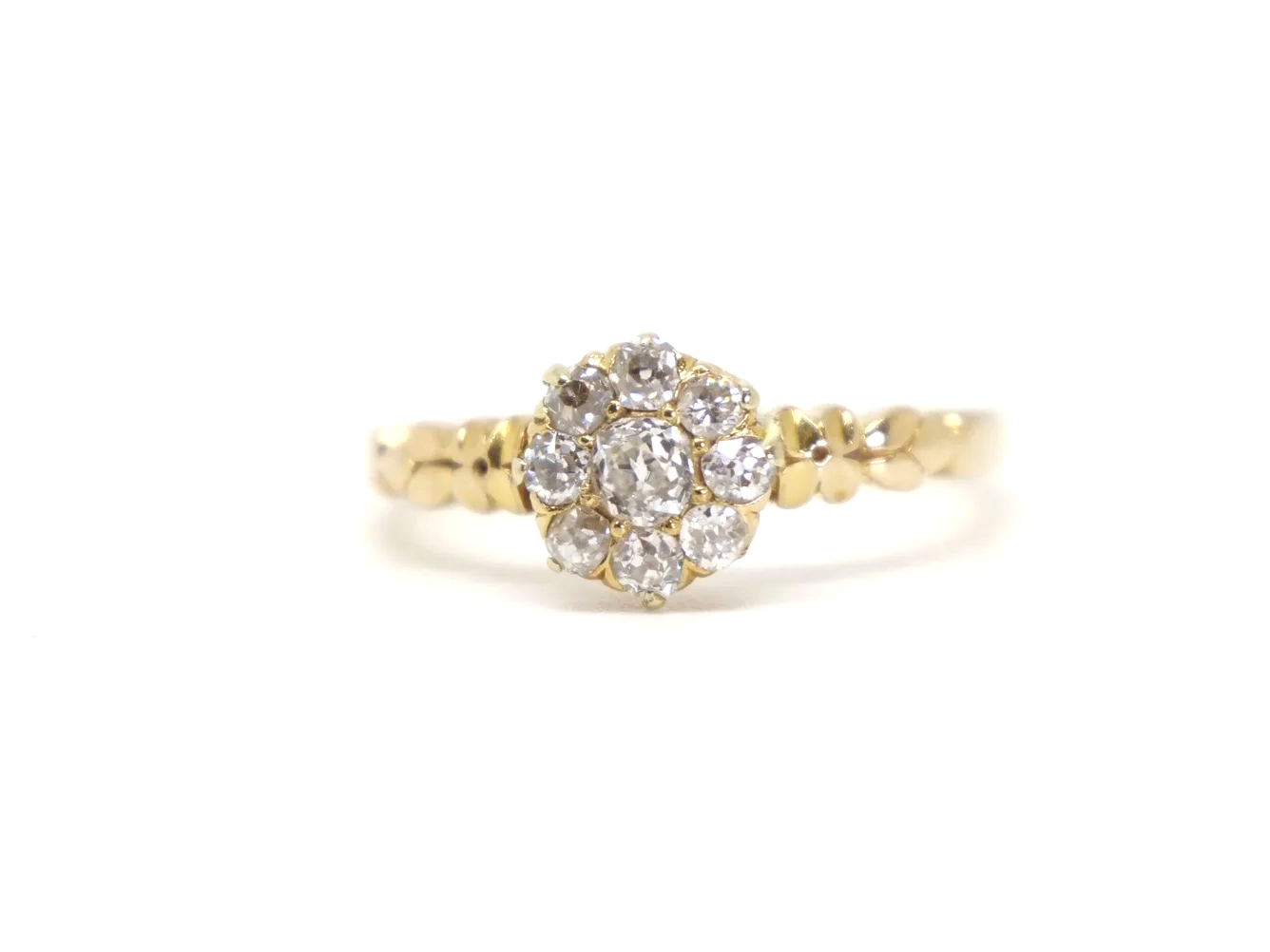
Stunning vintage 18ct gold old cut diamond daisy ring, set with lovely sparkly diamonds and gold etchings to each shoulder.
Store Location: Wallingford
Ring Size: M
Gemstones: Diamonds approximately 0.35ct total.
Hallmarks: Stamped 18 for 18ct gold.
Measurements: 9mm top to bottom.
Item Code: LF14
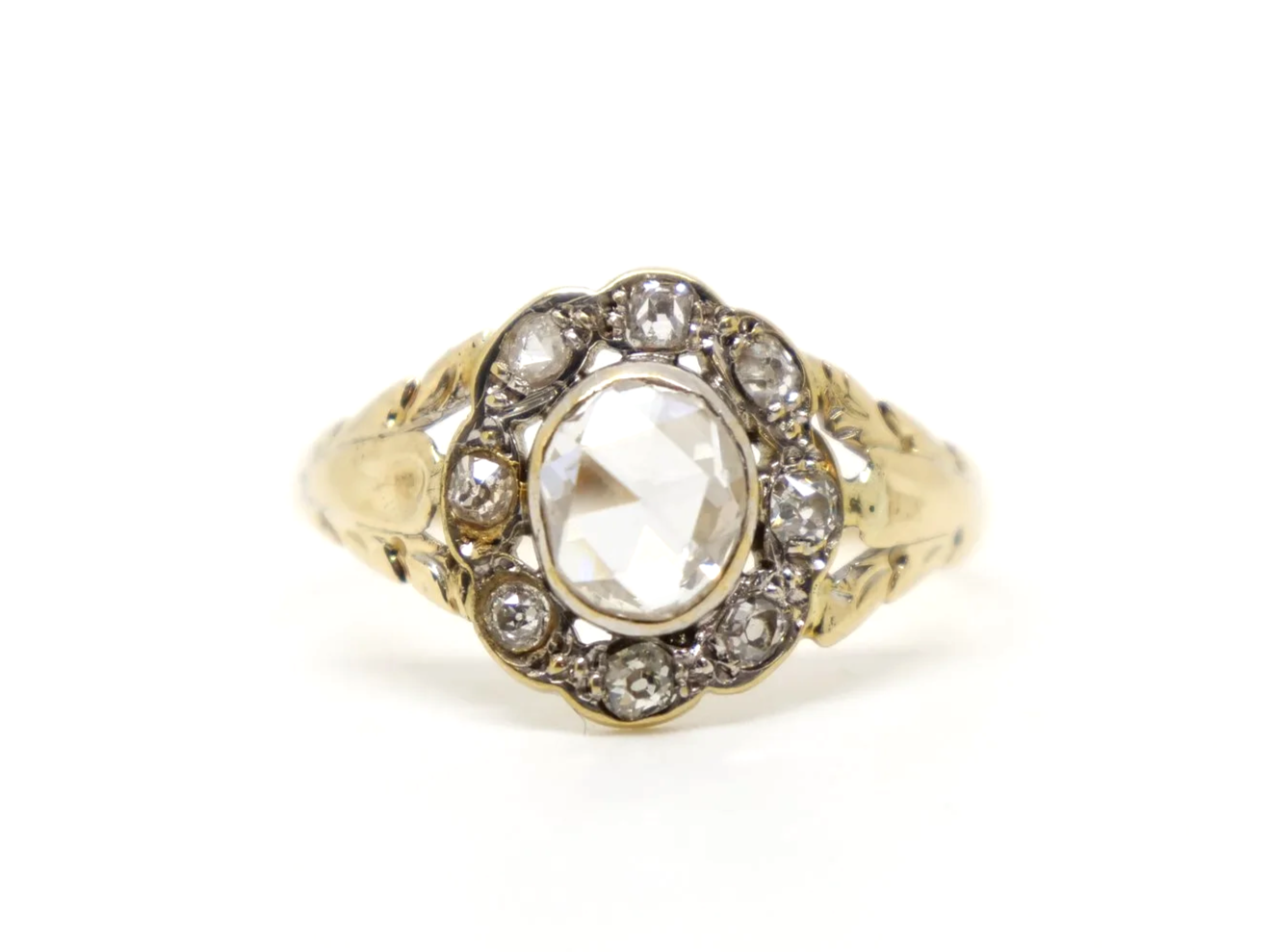
Gorgeous early Victorian 18ct gold rose and old cut diamond solitaire ring, set with a large central rose cut diamond and surrounded by old cut diamonds. Dating from the early Victorian period — most likely the 1840s to 1860s — it carries with it nearly two centuries of history.
The central stone is a rose cut diamond measuring 5.4 × 6.5mm — an oval rose cut of appreciable size, bezel set in gold collet at the heart of the ring. The rose cut is the oldest diamond cut you are likely to encounter in wearable jewellery: a flat-based, domed stone covered with triangular facets, with no pavilion beneath. It was the cut of choice before electric light existed, designed to catch and reflect candlelight with a soft, diffuse glow that is entirely unlike the intense brilliance of a modern diamond. In daylight it glows; in candlelight it comes alive. It is a stone with personality rather than performance, and increasingly it is exactly what a discerning buyer is looking for.
Surrounding the central rose cut is a scalloped halo of old cut diamonds totalling approximately 0.24 carats — smaller stones set in individual collets that follow the oval outline of the mount and echo the hand-made quality of the central stone.
The shoulders of the shank are hand-engraved with foliate decoration — a detail that is clearly visible and that places the ring firmly in the early Victorian tradition of richly decorated gold work. Engraving of this quality and delicacy was done entirely by hand, and it gives the ring a warmth and individuality that no modern piece can replicate. The shank is tested and confirmed as 18ct gold throughout.
Store Location: Hungerford
Ring Size: O 1/2
Gemstones: Approximately 0.24cts old cut diamonds, central rose cut diamond measuring 5.4 × 6.5mm.
Hallmarks: Unmarked, tested as 18ct gold.
Measurements: 13mm top to bottom
Item Code: LA96
Ring Resizing: Please choose the size you require once adding your item to your cart.

Wonderful antique sapphire and diamond half hoop ring, set with three round cut sapphires with an approximate total weight of 2.3cts. Set between each sapphire are two old cut diamonds. Beautiful light and colour in the sapphires. All set in 18ct gold.
Store Location: Hungerford
Ring Size: N 1/2
Gemstones: Central sapphire approximately 1ct, two further sapphires approximately 0.65cts each for a total of 2.3ct sapphires, diamonds total approximately 0.15cts.
Hallmarks: Rubbed makers mark, stamped 18ct and Chester 1886 date mark.
Item Code: JZ62
Ring Resizing: Please choose the size you require once adding your item to your cart.
Edwardian (1901–1910)
The Edwardian era saw the widespread adoption of platinum in fine jewellery, which transformed what was possible. Platinum's strength allowed jewellers to create settings of extraordinary delicacy — fine milgrain borders, pierced gallery work, and lace-like filigree that would have been impossible in gold. Edwardian rings typically feature old European cut diamonds in pale, elegant settings, often with a feminine lightness that remains enormously popular today. The use of platinum also means Edwardian rings have generally survived well — platinum does not wear down or corrode as gold can.
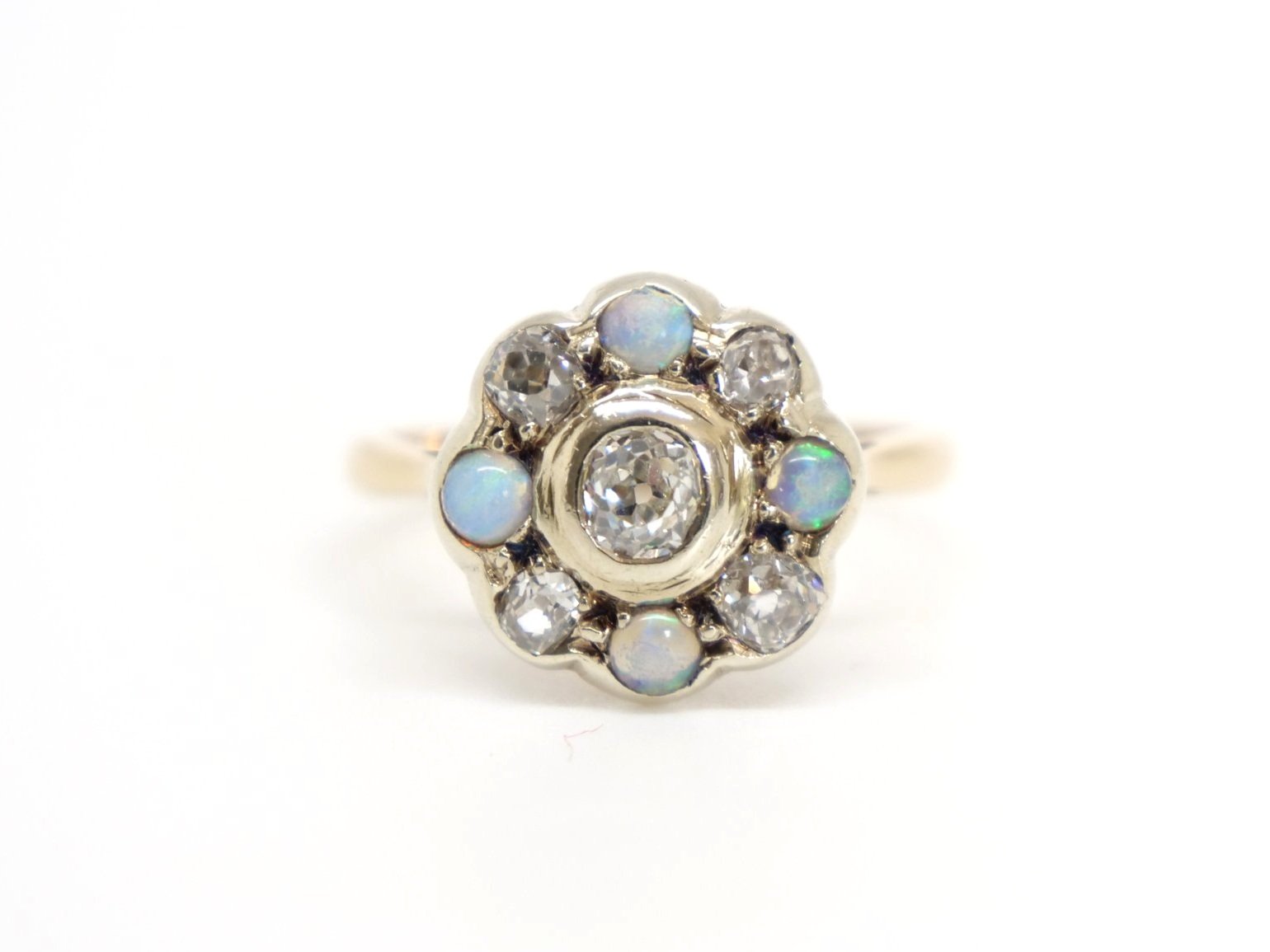
Very pretty 18ct gold Edwardian opal and diamond ring, with a central bezel set old cut diamond. Four further old cut diamonds and four opals surround.
Store Location: Hungerford
Ring Size: M
Gemstones: Old cut diamonds approximately 0.5ct.
Hallmarks: Stamped 18ct.
Measurements: 12mm top to bottom, 12mm wide.
Item Code: KL15
Ring Resizing: Please choose the size you require once adding your item to your cart.
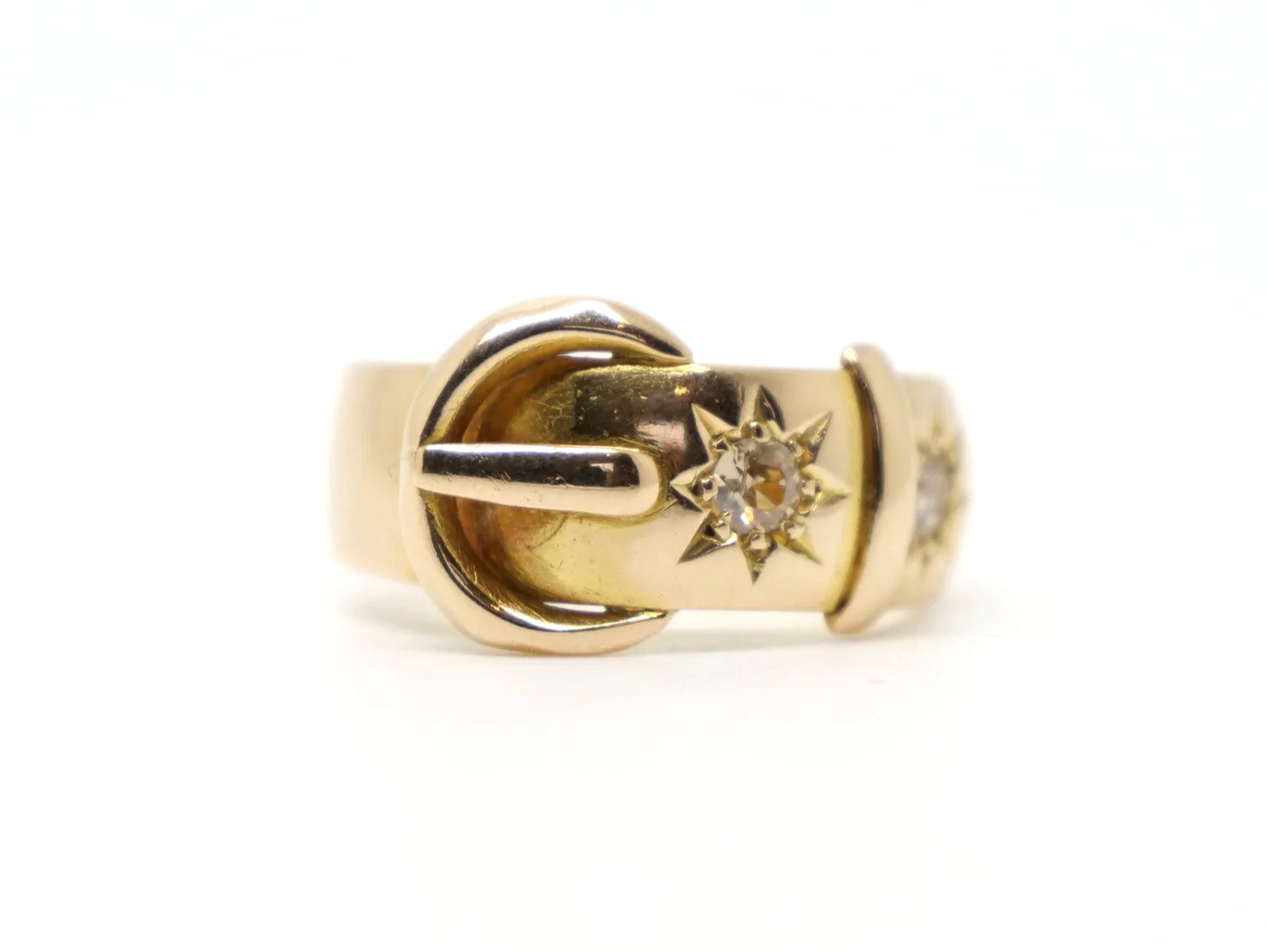
Fabulous antique 18ct gold diamond buckle ring (1910-1911), with a lovely wide band and set with approximately 0.3ct old cut diamonds.
Store Location: Hungerford
Ring Size: R
Gemstones: Old cut diamonds approximately 0.3ct total.
Hallmarks: Stamped 18ct and 1910-11 date stamp.
Measurements: 12mm top to bottom at widest point.
Item Code: LA82
Ring Resizing: Please contact us for resizing over 2 sizes.
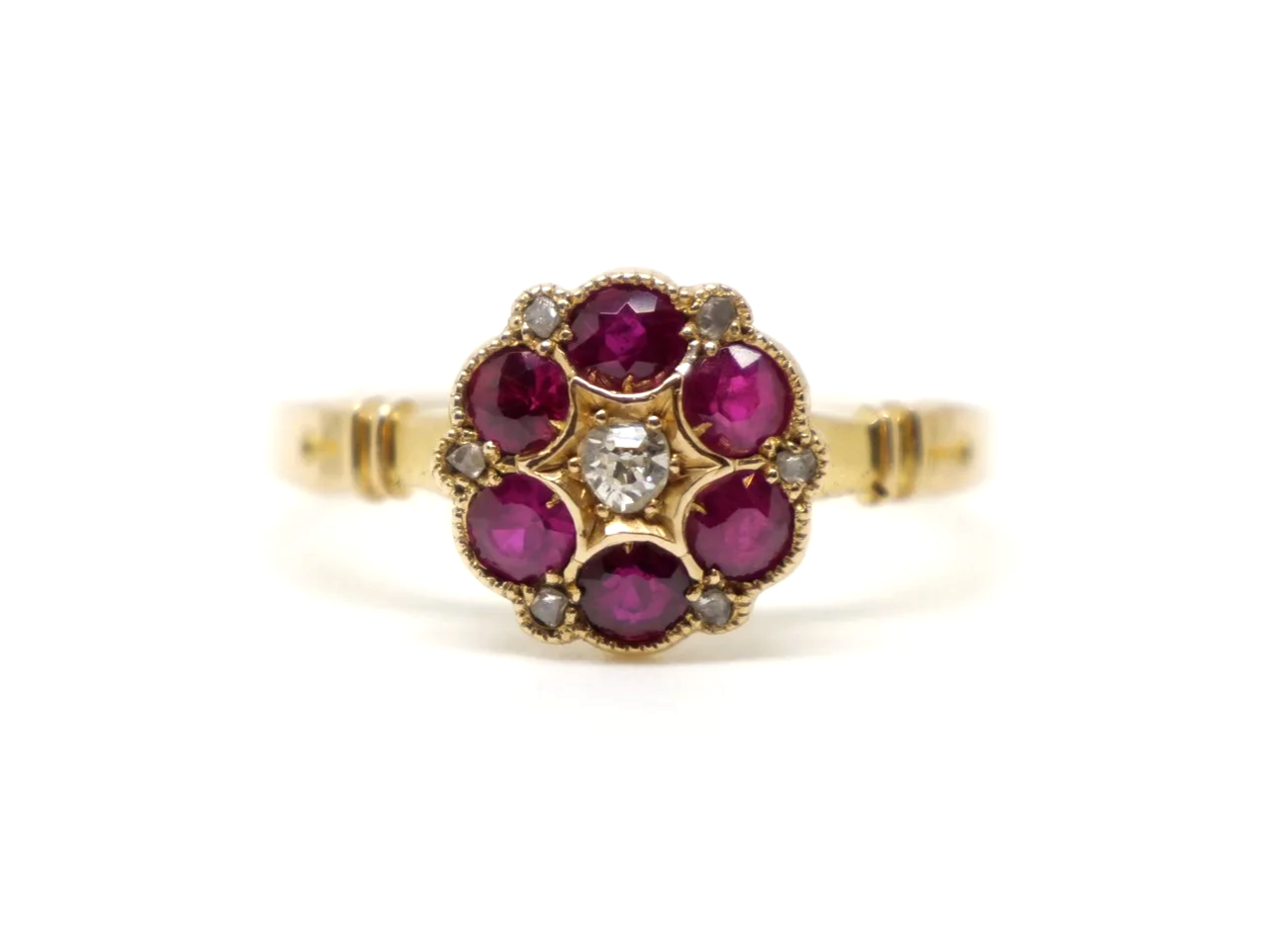
Beautiful 18ct gold Edwardian ruby and diamond daisy ring, set with six round cut rubies and old cut diamonds. Stamped Chester and date mark for 1912.
Store Location: Cirencester
Ring Size: L
Gemstones: Rubies approximately 0.9ct, old cut diamonds approximately 0.09ct
Hallmarks: Stamped 18 for 18ct gold and Chester 1912/13 date stamp.
Measurements: 9mm top to bottom, 9mm wide.
Item Code: LE85
Art Nouveau (1890–1910)
Overlapping with the late Victorian and Edwardian periods, Art Nouveau jewellery was a deliberate reaction against industrialisation — a movement that celebrated nature, asymmetry, and flowing organic forms. Dragonflies, flowers, female figures, and enamel work are characteristic. Art Nouveau engagement rings are relatively uncommon (the style was not ideally suited to the solitaire format) but pendants, brooches, and earrings from this period are among the most artistically significant pieces in any collection.
Art Deco (1920s–1930s)
Perhaps the most popular period for antique engagement rings today, and for good reason. Art Deco jewellery is geometric, architectural, and precise — bold lines, strong symmetry, and the liberal use of platinum and white diamonds give it a modernity that sits perfectly alongside contemporary fashion. The contrast between the white brilliance of the diamonds and the cool metallic platinum is characteristic of the period. Old European cut diamonds in clean, elegant settings — often with distinctive stepped shoulders or geometric detail — make Art Deco rings outstanding engagement ring choices.
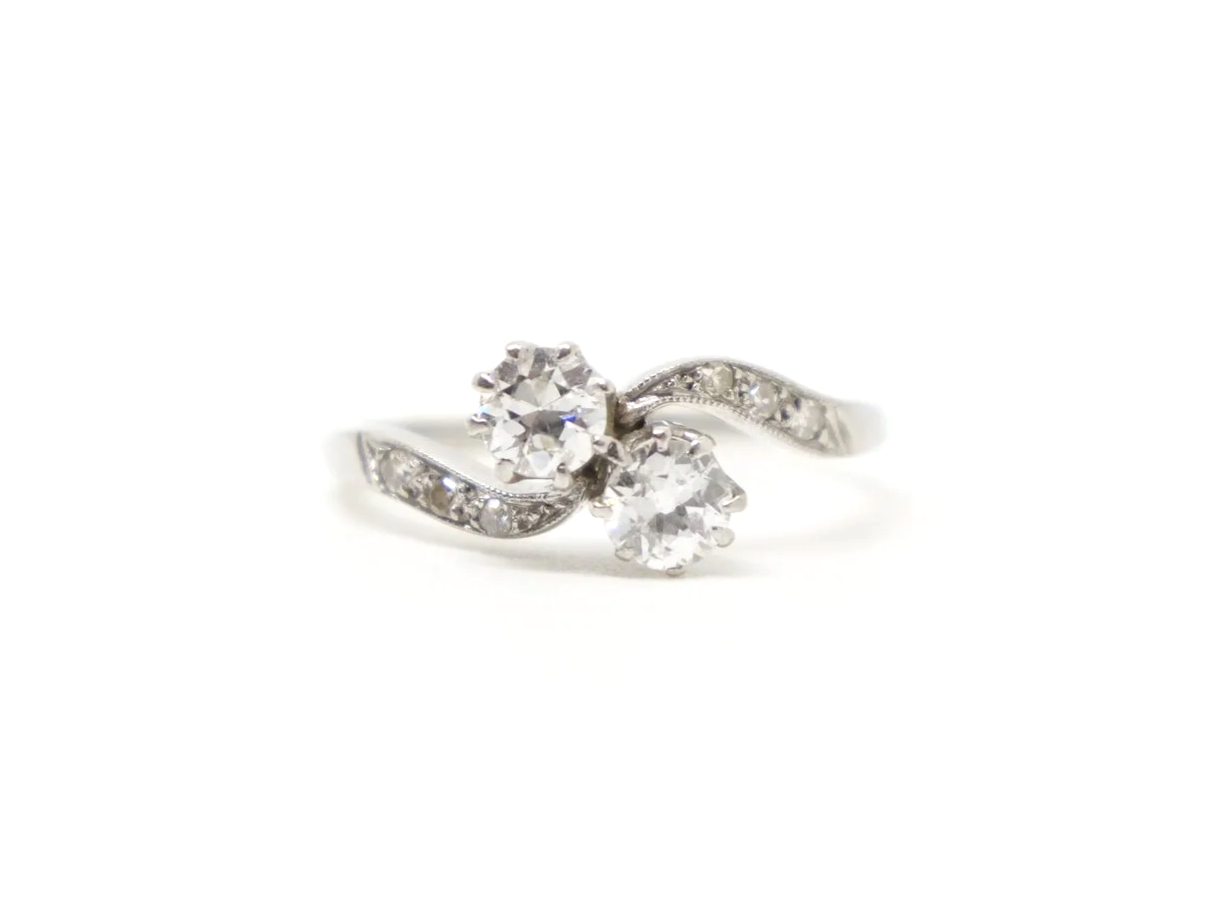
Super platinum diamond toi et moi ring, set with two old cut diamonds, with further diamonds set into each shoulder.
Store Location: Hungerford
Ring Size: I
Gemstones: Old cut diamonds approximately 0.5ct, diamonds total approximately 0.54ct.
Hallmarks: Unmarked, tested as platinum.
Measurements: 8mm top to bottom
Item Code: LF76

Stunning platinum Art Deco old cut diamond solitaire ring, set with a gorgeous, clear old cut diamond, with further diamonds to each shoulder. The centre stone is an old cut diamond of approximately 1.35 carats, set in a classic eight-claw platinum mount that holds the stone high and allows light to reach it from every angle. Old cut diamonds of this size have a character that modern brilliant cuts simply do not replicate — cut by hand before the age of machine precision, they have a larger culet (visible as the characteristic circle at the centre of the stone when viewed from above), a higher crown, and a play of light that is softer and more romantic than the intense flash of a contemporary diamond. In platinum, under any light, this stone is genuinely beautiful.
The shoulders are set with single cut diamonds — small, early-cut stones with fewer facets than a modern brilliant, entirely in keeping with the period and adding a continuous line of sparkle along both sides of the band without drawing attention away from the centre stone. Total diamond weight is approximately 1.44 carats.
Store Location: Hungerford
Ring Size:N
Gemstones: Central old cut diamond approximately 1.35ct, approximately 1.44ct diamonds total.
Hallmarks: Unmarked, tested as platinum.
Measurements: 7.2mm top to bottom
Item Code: LC1
Ring Resizing: Please contact us to view this item.
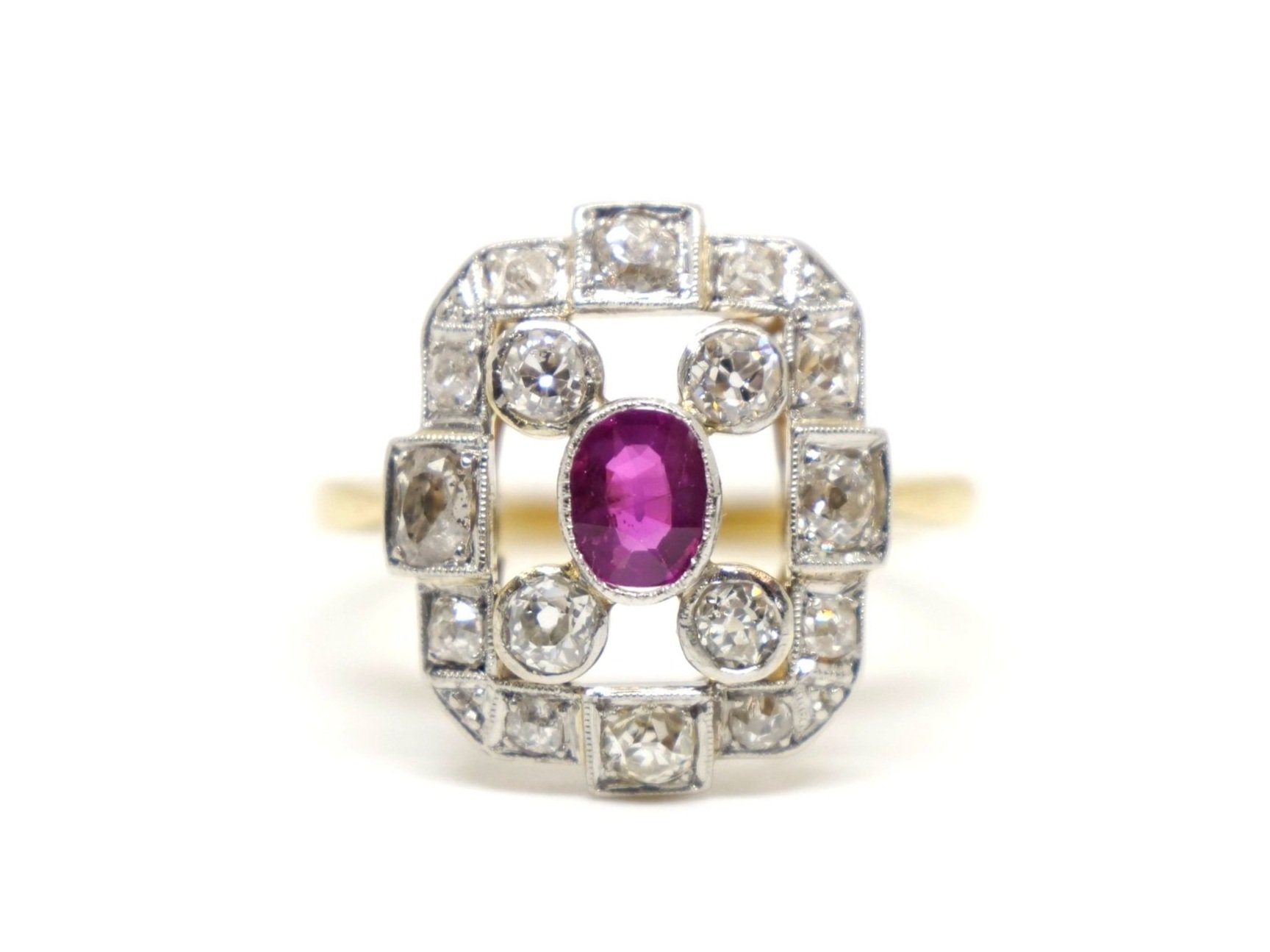
Superb 18ct gold and platinum Art Deco ruby and diamond ring, set with a central oval cut ruby with old cut diamonds to each corner. Further diamonds in a halo effect.
This is Art Deco jewellery at its most architectural — an open, pierced rectangular mount in platinum and gold, built around a vivid oval cut ruby with old cut diamonds arranged with the geometric precision that defines the period.
The central stone is an oval cut ruby of approximately 0.50 carats, bezel set in platinum at the heart of the composition — a vivid, saturated pink-red that provides an immediate focal point against the white of the diamonds and metal surrounding it.
Surrounding the ruby, the diamond arrangement is what makes this ring genuinely unusual. Four larger old cut diamonds are set at the cardinal points — top, bottom, and each side — in individual collet mounts with milgrain borders, forming an inner cross around the ruby. Beyond these, a continuous rectangular frame of smaller old cut diamonds follows the outer edge of the mount, set in alternating square and round collets with further milgrain detailing throughout. The gallery between the inner diamond cross and the outer diamond border is open and pierced — a construction detail that gives the ring its characteristic Art Deco lightness, allowing light to pass through the mount and reducing the visual weight of what is a substantial 17mm ring considerably.
Total diamond weight is approximately 0.90 carats across all stones — old cuts throughout, with their characteristic warmth and hand-cut individuality. The mount is platinum for the diamond and stone settings, with an 18ct yellow gold shank — the classic two-tone construction of the finest Art Deco jewellery.
Store Location: Hungerford
Ring Size: O
Gemstones: Central oval cut ruby of approximately 0.5ct, old cut diamonds approximately 0.9cts total.
Hallmarks: Unmarked, tested for 18ct and platinum.
Measurements: 17mm top to bottom, 15mm wide
Item Code: KP6
Ring Resizing: Please choose the size you require once adding your item to your cart.
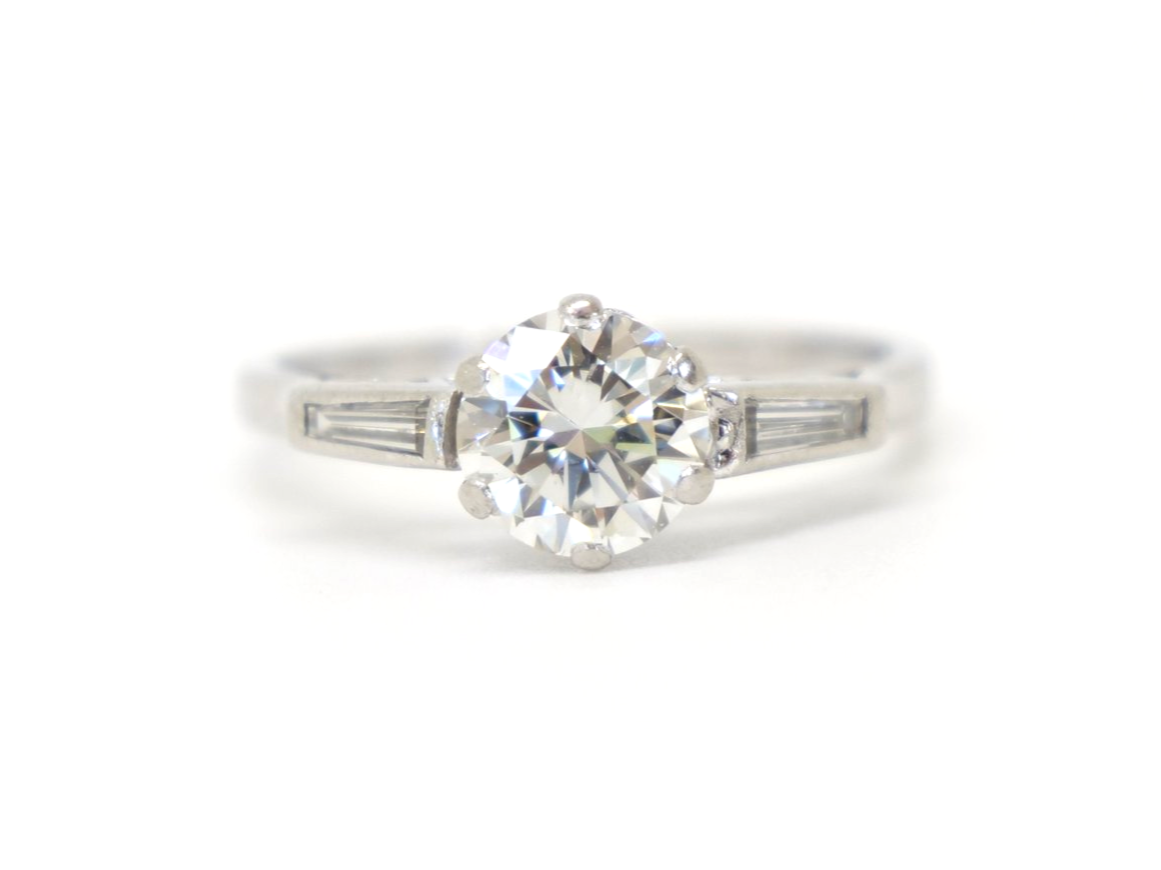
Stunning platinum Art Deco diamond solitaire ring, set with a gorgeous central brilliant cut diamond, with a baguette cut diamond to each side. Approximately 1.25cts total diamonds.
Store Location: Hungerford
Ring Size: M
Gemstones: Central brilliant cut diamond approximately 1.18ct, with baguette cut diamond shoulders approximately 1.25ct total.
Hallmarks: Unmarked, tested as platinum.
Measurements: 7mm top to bottom, 17mm wide
Item Code: KJ24
Ring Resizing: Please choose the size you require once adding your item to your cart.
Mid-century vintage (1940s–1970s)
The post-war decades saw a shift from platinum (which was restricted for military use during the Second World War) back to gold, and a move towards bolder, more sculptural designs. Yellow gold cluster rings, three-stone rings, and flower or daisy motif rings are characteristic of this period. These pieces often represent exceptional value and are increasingly appreciated by buyers who want vintage character at a more accessible price point.
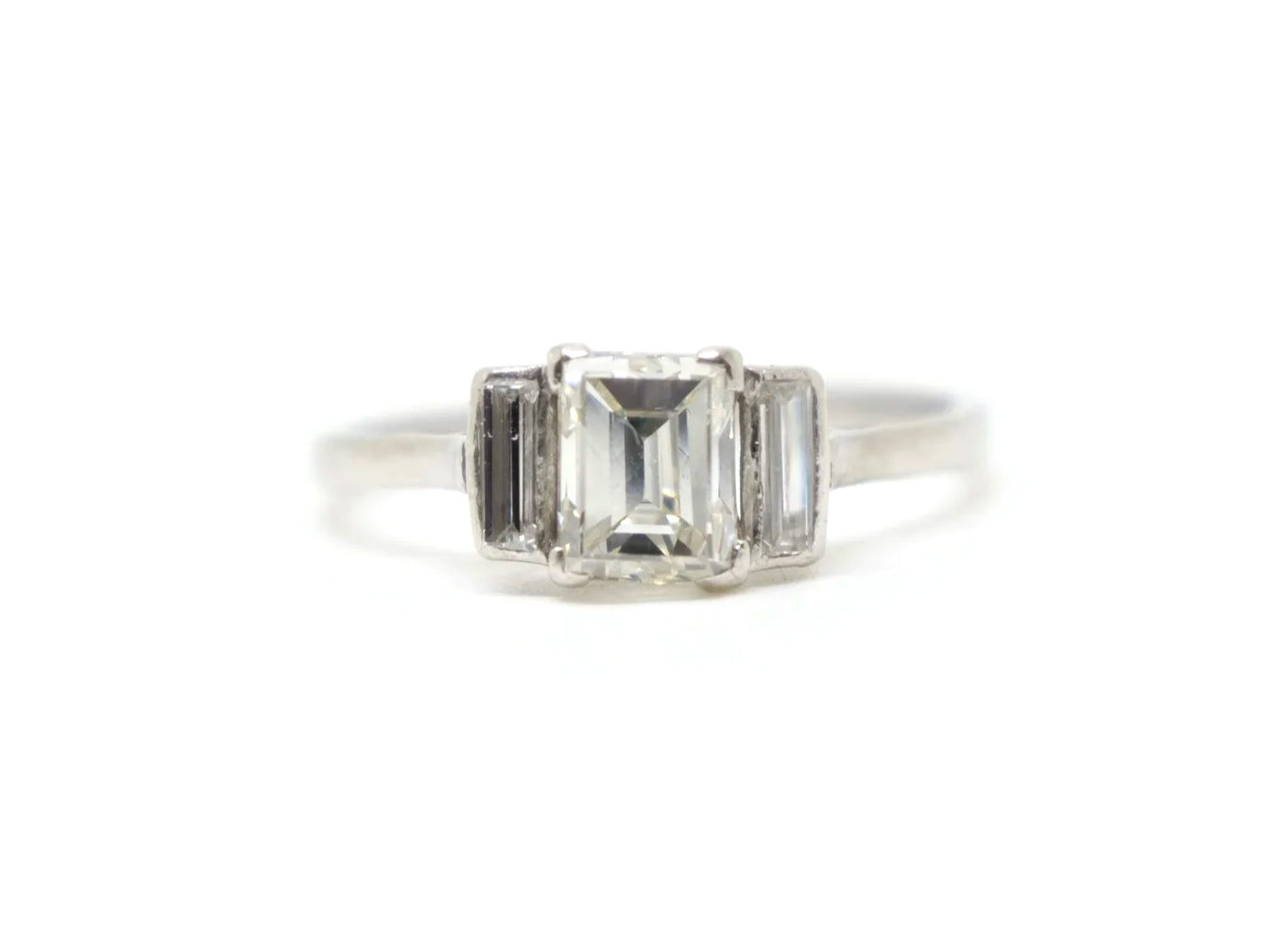
Very unusual vintage platinum diamond ring, set with a lovely baguette cut diamond of approximately 0.95ct. Two further baguette cut diamonds for a total of approximately 1.25ct.
The centre stone is a baguette cut diamond of approximately 0.95 carats — a substantial stone for this cut, which is more commonly encountered in smaller sizes as a shoulder or accent stone rather than as a centre piece in its own right. A baguette of this size has a long, open table that displays the stone's clarity and colour with complete transparency — there is nowhere to hide in a step cut, which makes a clean, bright stone of this size genuinely impressive. To each side sits a further baguette diamond, the three stones sitting flush in a continuous horizontal setting that gives the ring its distinctive linear character. Total diamond weight is approximately 1.25 carats.
The all-baguette three-stone ring is an unusual choice that places this firmly outside the mainstream — most three-stone rings use round brilliant cuts, and the decision to use baguettes throughout gives this ring a graphic, architectural quality that suits the 1950s period of its manufacture. Step cuts were at the height of their popularity in the post-war decades, when the clean lines of modernist design influenced jewellery as much as architecture and furniture.
The mount is platinum throughout, tested and confirmed, though unmarked — not uncommon for pieces of this period. Slim and well-proportioned at 6mm top to bottom, it sits elegantly on the finger without bulk.
Store Location: Hungerford
Ring Size: L 1/2
Gemstones: Centre diamond approximately 0.95ct, total diamonds approximately 1.25ct.
Hallmarks: Unmarked, tested for platinum.
Measurements: 6mm top to bottom.
Item Code: LF62
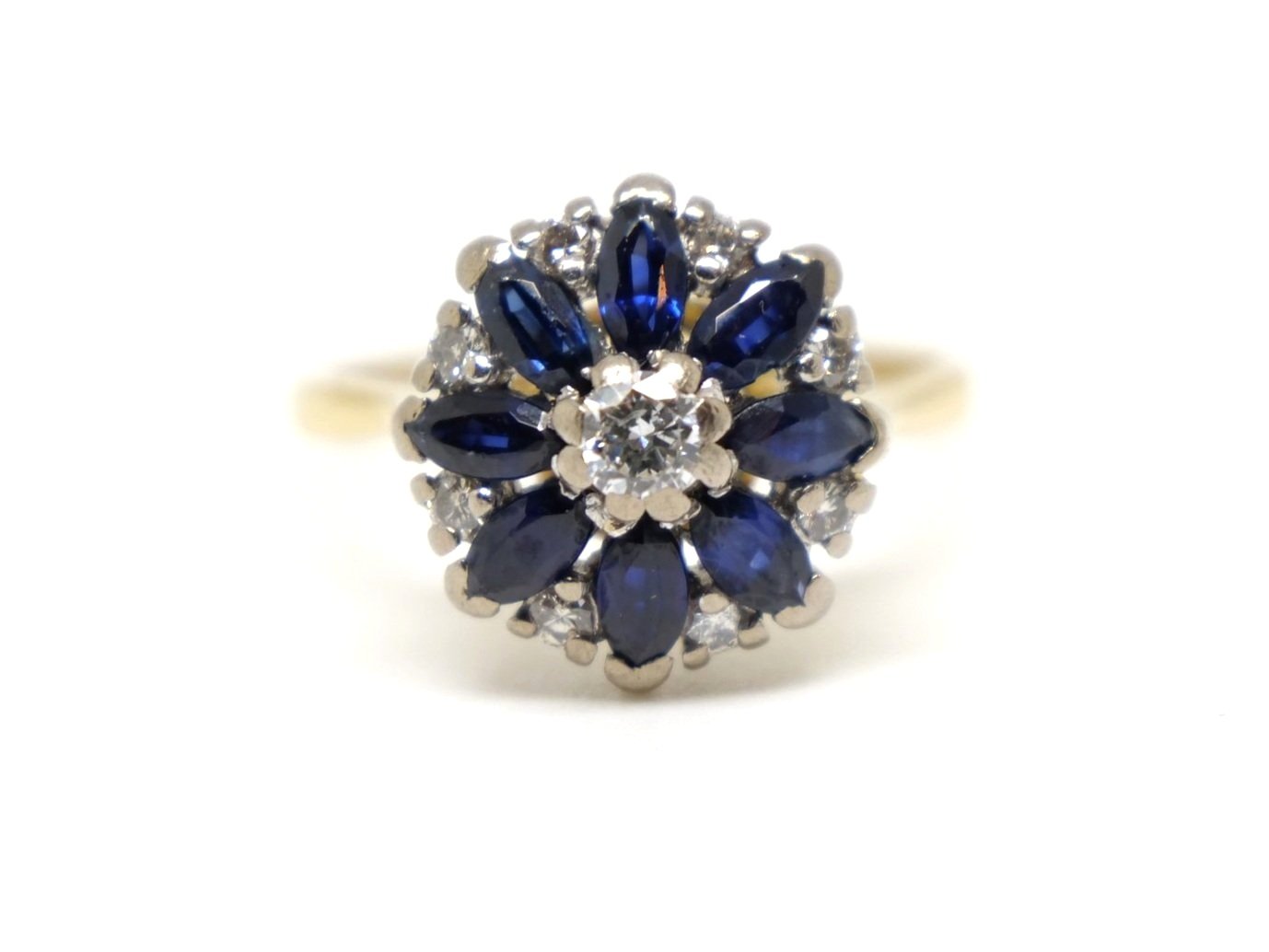
Unusual vintage 18ct gold sapphire and diamond ring, set with marquise cut sapphires and set with brilliant cut diamonds in this lovely geometrical floral design.
Store Location: Hungerford
Ring Size: L 1/2
Gemstones: Sapphires marquise cut approximately 1.2cts, brilliant cut diamonds approximately 0.34cts total.
Hallmarks: Hallmarks rubbed, tested as 18ct gold.
Measurements: 12mm top to bottom
Item Code: KP7
Ring Resizing: Please choose the size you require once adding your item to your cart.
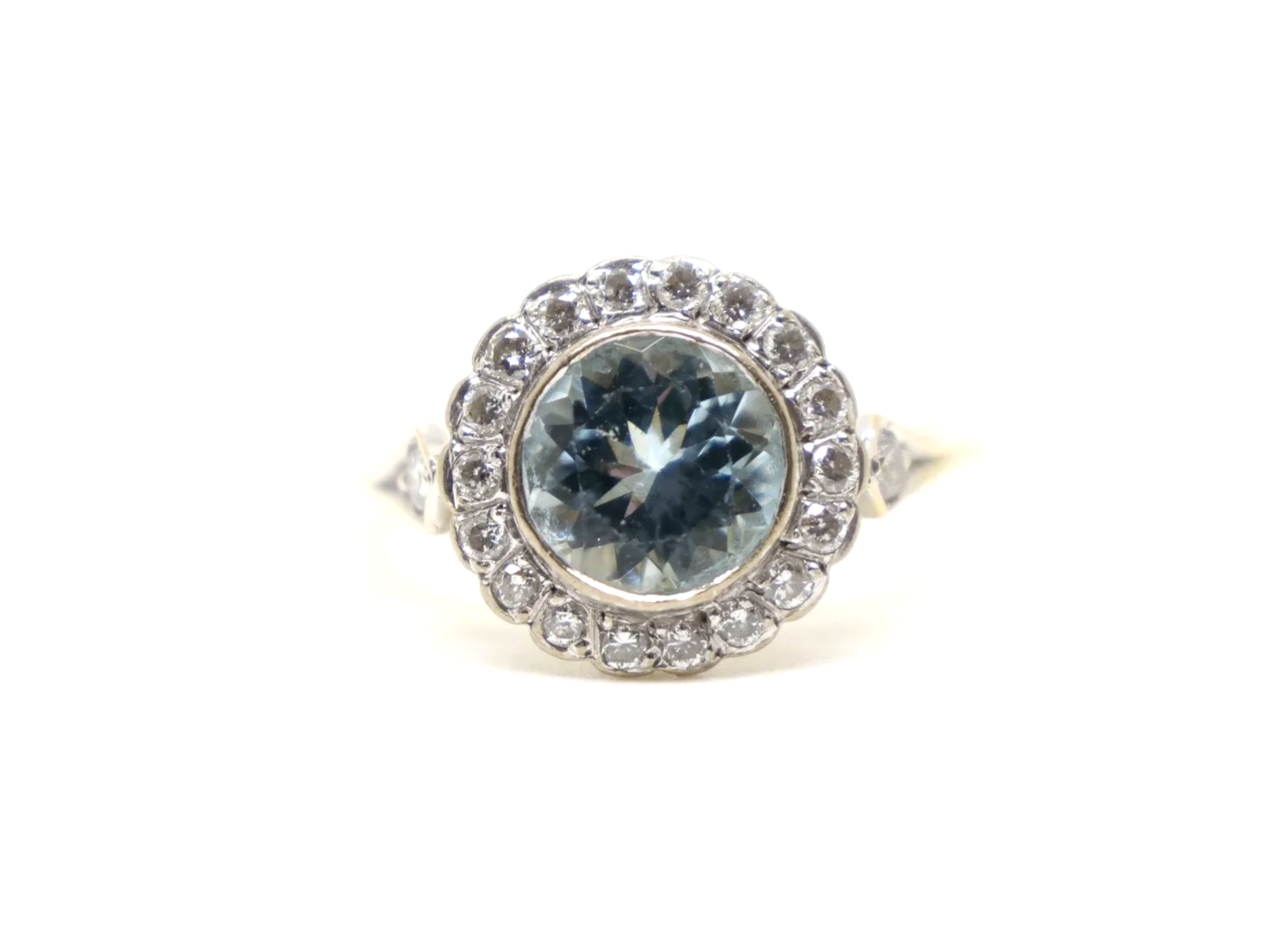
Stunning 18ct gold vintage aquamarine and diamond ring, set with a central round cut aquamarine of approximately 2.4ct, and surrounded by diamonds. Further diamonds to each shoulder.
Store Location: Hungerford
Ring Size: P
Gemstones: Central round cut aquamarine approximately 2.4ct, diamonds approximately 0.33ct.
Hallmarks: Stamped 18ct for 18ct gold.
Measurements: 13mm top to bottom.
Item Code: LF66
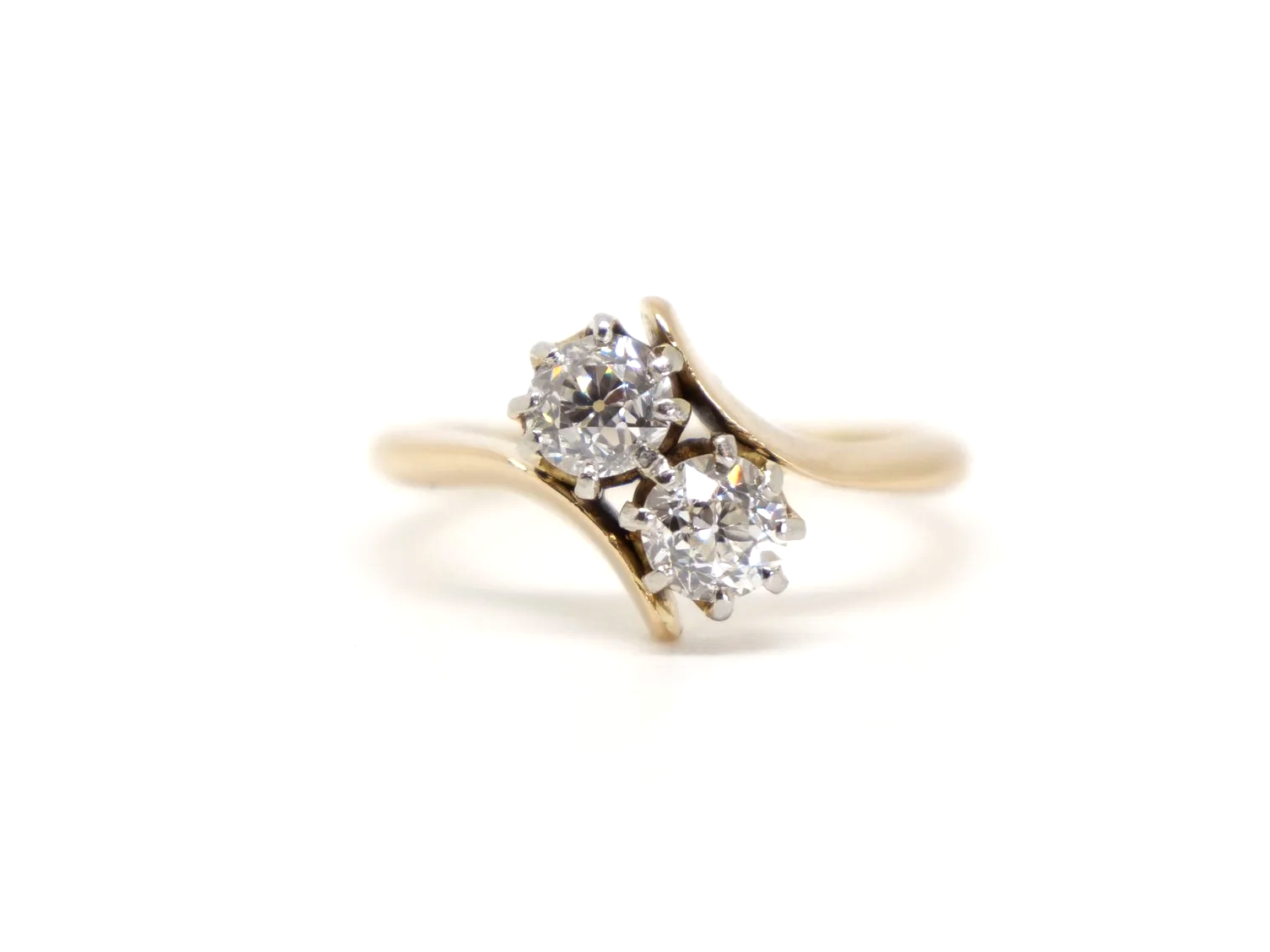
Gorgeous vintage 18ct gold diamond toi et moi ring, set with two lovely old cut diamonds, with approximately 0.7ct diamond weight.
Store Location: Hungerford
Ring Size: K 1/2
Gemstones: Old cut diamonds approximately 0.7ct total.
Hallmarks: Stamped 18ct for 18ct gold.
Measurements: 11mm top to bottom.
Item Code: LF29
Understanding Antique Diamonds: The Old Cuts
The diamonds in antique rings were cut very differently from modern stones, and understanding the difference will help you appreciate what you are looking at.
Rose cut
The oldest cut you are likely to encounter in rings, common from the Georgian and Victorian periods. A rose cut diamond has a flat base and a domed top covered with triangular facets — there is no pavilion (the pointed underside of a modern diamond). Rose cuts have a soft, gentle sparkle rather than the intense fire of a modern brilliant — they glow rather than flash, which many people find deeply appealing. In thin or delicate settings, a rose cut diamond's flat profile makes it particularly comfortable to wear.
Old mine cut
The forerunner of the modern round brilliant, common in Victorian jewellery. Old mine cuts have a cushion-shaped outline, a high crown, a small table facet (the flat top), and a large culet (the flat facet at the very bottom of the stone). That large culet, when viewed through the table, creates a distinctive dark circle at the centre of the stone — once you know to look for it, it is an unmistakeable marker of a genuinely old diamond. Old mine cuts have tremendous character and warmth.
Old European cut
The immediate predecessor to the modern round brilliant, common in Edwardian and Art Deco jewellery. Old European cuts are round in outline but, like the old mine cut, have a higher crown, smaller table, and larger culet than a modern stone. They were cut by eye rather than by machine, which means they often have a hand-finished quality — a slight asymmetry — that gives them personality. In platinum Edwardian or Art Deco settings, an old European cut diamond is one of the most beautiful things in fine jewellery.
Modern brilliant cut
For completeness: modern brilliant cuts, developed in the early twentieth century and refined throughout the 1900s, are designed to maximise the reflection of light for the strongest possible sparkle. They are technically precise and undeniably brilliant — but they lack the warmth and individuality of the old cuts. Occasionally you will find a vintage ring that has been recut or remodelled with a modern stone; our team will always tell you if this is the case.
Hallmarks: how to read authenticity
British hallmarks are one of the great advantages of buying antique jewellery in the UK. Since 1300, it has been illegal to sell gold, silver, or platinum without it first being assayed and stamped by an official Assay Office.
A full British hallmark contains:
The maker's mark — the initials or symbol of the manufacturer
The assay office mark — a crown (Sheffield), anchor (Birmingham), leopard's head (London), or castle (Edinburgh)
The metal and purity mark — the carat of gold (9ct, 18ct, 22ct) or the millesimal fineness of platinum (950)
The date letter — a letter within a shield shape that corresponds to a specific year, allowing precise dating of British pieces
Learning to read date letters takes practice, but even a basic familiarity with hallmarks means you can immediately verify the age and metal content of any British piece. Our GIA Diamond Graduate team is always happy to walk you through the hallmarks on any piece in our collection.
What to look for in condition
Antique rings have been worn — often for decades. Some wear is expected, acceptable, and part of their character. But there are things to look for that indicate a ring is in sound condition versus one that needs significant work.
Claws and settings. Check that all claws (the metal prongs holding the stone) are intact, even in height, and not bent or broken. Worn claws are the most common reason stones become loose in antique rings. This is repairable, but good to know about before purchase.
Shank thickness. The shank is the band of the ring. With age and wear, shanks can become very thin — particularly on rings that have been sized multiple times. A very thin shank may need reinforcement. Our team measures shank thickness on every piece we sell.
Stone security. Gently tap the ring on a hard surface and listen — a rattling sound suggests a stone is loose. Every ring in our collection is checked for stone security before being offered for sale.
Hallmarks. Legibility of hallmarks is a good general indicator of how much wear a ring has sustained. Hallmarks on a heavily worn ring may be partially polished away.
Repairs. Solder lines (visible joins), replaced claws, or retipped settings are all routine repairs in antique jewellery and are not necessarily a problem, but they should be checked.
Buying online versus in person
We sell both online and from our Hungerford boutique, and there are genuine advantages to both.
Buying in person allows you to see the ring on your hand, assess scale (photographs can be misleading), and have any questions answered immediately by our team. If you are within reasonable travelling distance of Berkshire, we warmly encourage a visit. As our jewellery is spread across several locations, please contact us ahead of your visit so we can ensure the pieces you are interested in are available to see.
Buying online from a specialist dealer like Antique Jewellery Boutique is safe and straightforward, provided you buy from a business with a clear returns policy. Ours is a 100% no-quibble money-back guarantee: if the ring is not right for you, return it within seven days for a full refund. We also provide detailed descriptions, multiple photographs, and are always available to answer questions before you commit. We would be very happy to have a video appointment should you wish to see something in particular.
Ring sizing and antique rings
Most antique rings can be resized by a skilled jeweller. We offer a professional resizing service in-house, which typically takes 7–10 days. For all rings purchased over £1,000, resizing is complimentary up to 3 sizes. For rings under £500, a fee of £60 or more applies depending on the work required.
Some intricate designs — particularly those with patterned or set shoulders that continue around the full circumference of the band — are more challenging to resize, and we will always advise you before any work is undertaken. If you are unsure of your ring size, we can advise on how to measure at home, or you can visit any jeweller for a quick sizing.
Our expertise: why it matters
Every piece in our collection is selected and assessed by a family member, with over 25 years of experience. We also have a GIA Diamond Graduate — a qualification awarded by the Gemological Institute of America, the world's foremost authority on diamonds and coloured gemstones. GIA Diamond Graduates are trained to evaluate diamonds for cut, colour, clarity, and carat weight to an internationally recognised standard.
This means that when we describe a diamond as an old European cut of good colour and clarity, that assessment comes from trained expertise rather than enthusiasm. We believe transparency about what you are buying is fundamental — which is why we always describe stones accurately, note any treatments or repairs, and encourage questions.
We are a three-generation family business, established in Hungerford for over 25 years. Antique and vintage jewellery is not a sideline for us — it is all we do, and we approach every piece with the care and knowledge that reflects that.
Ready to explore?
Browse our current collection of antique and vintage rings, including a dedicated selection of rings under £500 for those beginning their search. If you have questions about any piece, or would like to discuss what you are looking for before browsing, please get in touch — we would be delighted to help.
You may also find our FAQ page useful, which covers common questions about buying, caring for, and selling antique jewellery.
Antique Jewellery Boutique | 26–27 High Street, Hungerford, Berkshire, RG17 0NF | 01491 640 877 | enquiries@antiquejewelleryboutique.com